

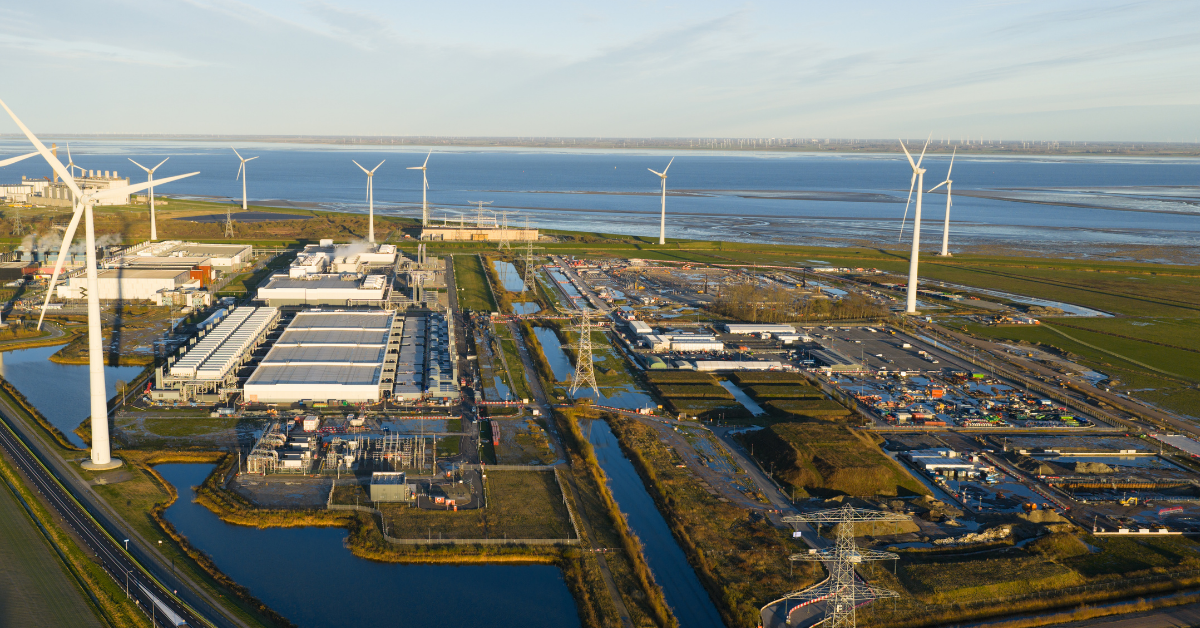
Water access is one of the four criteria in the site readiness gap, and it's the one many site selectors verify last. Power, fiber, and zoning are the criteria that land teams have the most established research workflows for. Water tends to be treated as a confirmatory step rather than a primary screen, verified after the other three criteria have been satisfied, as a box-checking exercise before due diligence is commissioned.
Water is not uniformly the most difficult criterion to satisfy. In many markets, municipal systems have ample capacity and the water screen is genuinely straightforward. But in the markets and geographies where water is constrained, a late discovery of that constraint can be among the most costly and disruptive outcomes for a project. Acres.com surfaces nationwide water access context, giving development teams the data to evaluate water access posture alongside the other site readiness criteria from the beginning.
Why Has Water Become a Critical Path Item in Data Center Development?
Hyperscale data centers can require as much as 3 to 5 million gallons per day of water for cooling operations. At that scale, daily demand is roughly equivalent to the municipal water use of a town of 10,000 to 50,000 people. Projections indicate that annual onsite water consumption by U.S. data centers could double or quadruple by 2028.
The cooling demand is not fixed. It depends on the facility's cooling system design. Evaporative cooling, while often the most energy-efficient approach in warm, dry climates, is typically among the most water-intensive cooling methods. A hyperscale campus using evaporative cooling can draw water at a rate that requires dedicated water infrastructure investment from the municipal system, including elevated storage, expanded treatment capacity, and in some cases new source water agreements at the regional level.
$156 billion data center projects were delayed or cancelled in 2025, while more than $130 billion in data center projects was delayed or abandoned in the first quarter of 2026 alone. Much of it is driven by community concerns about power draw, water consumption, and environmental impact. For developers entering greenfield sites in 2026, water permitting timelines, local hydrological studies, and community water impact assessments are now on the critical path alongside grid interconnection and planning consent.
What Water Variables Does a Site Screen Need to Evaluate?
Several of those legislative actions on bans or moratoriums are directly tied to water concerns, as communities near proposed data centers raise concerns about municipal water capacity and wastewater and blowdown discharge impacts on municipal treatment systems and local watersheds.
|
Water Criterion |
What to Evaluate |
Risk Level by Geography |
Failure Mode |
|---|---|---|---|
|
Municipal supply capacity |
Can the local public water utility deliver the peak gallons per day (GPD) required without exceeding its daily system capacity? |
High in fast-growing sunbelt markets; moderate in established Northeast and Midwest |
System at capacity; utility denies new large-scale hookups |
|
Water rights (prior appropriation) |
Does the project site hold or can it acquire senior water rights? |
Critical in Western states governed by prior appropriation law (CO, AZ, NV, WA, ID, UT, OR) |
Junior rights curtailed during drought, cutting off cooling water supply |
|
Wastewater & blowdown discharge |
Can the local municipal sewer system accept cooling wastewater (blowdown), or is a direct discharge permit needed for nearby surface waters? |
High in sewer-constrained networks or near sensitive watersheds (e.g., Northern Virginia); lower in large metropolitan treatment systems. |
Permit denied or conditioned on zero-discharge requirements; the project may require costly closed-loop/zero-discharge systems. |
|
Groundwater access |
Is drilling on-site wells a legally and hydrologically viable option for backup or primary cooling? |
High in state-designated critical groundwater management areas; varies widely by local basin rules. |
Aquifer basin is legally closed to new well permits, or well output/quality is inadequate for cooling equipment. |
|
Drought resilience |
Can the water supplier maintain continuous industrial delivery through multi-year droughts or emergency rationing? |
High in arid West; growing concern in Southeast and Texas |
Mandatory community drought curtailments force operators to throttle operations or switch to expensive backup cooling. |
Disclaimer: This table is provided for general informational purposes only and outlines typical industry practices and regulatory frameworks. It does not constitute legal, environmental, engineering, or professional real estate due diligence advice. Water laws, permitting thresholds, and utility interconnection rules vary by state, water basin, and municipal jurisdiction, and are subject to legislative and administrative updates. Project developers should consult qualified professionals to perform site-specific hydrogeological and regulatory evaluations before making acquisition or development decisions.
|
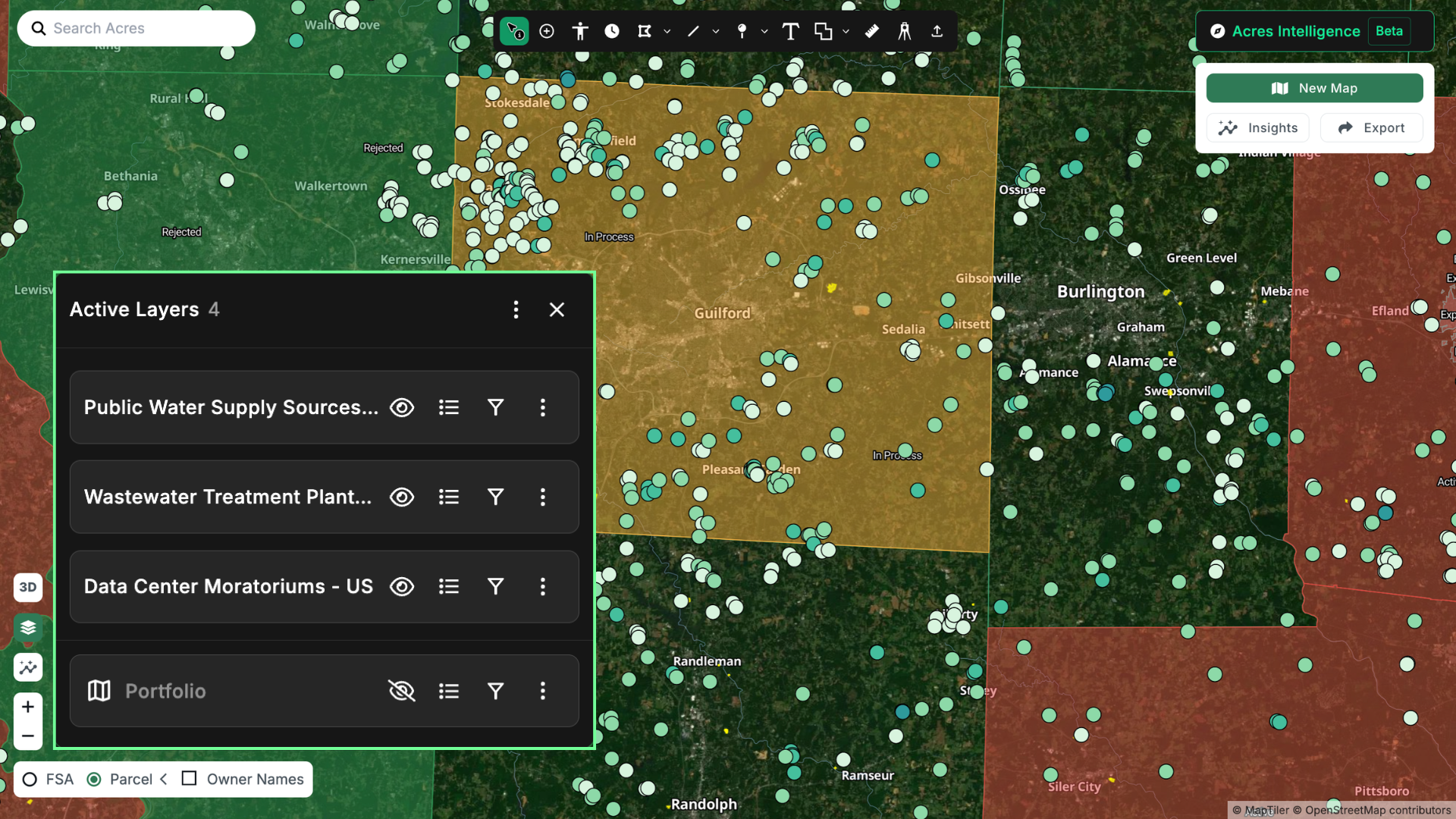
With Acres: Acres gives teams a nationwide view of data center moratoriums. Updated weekly, this offers visibility into which markets have current bans, bans in process, lifted bans, and more statuses. Acres also provides parcel-level water access data such as mains, wells, public water supply, and more. |
What Does the Water Rights Framework Look Like in Western States?
In Western states, water rights follow the doctrine of prior appropriation: first in time, first in right. Unlike systems where shortages are shared proportionally among users, prior appropriation dictates that 'senior' users receive their full legal allocation first—meaning a newer industrial user holding junior rights can see its water supply curtailed during severe drought calls.
For data centers in prior appropriation states, the water rights screen has a different structure from the municipal capacity screen. A municipal capacity screen asks whether the utility system can serve the project's daily demand. A water rights screen asks whether the project site holds, or can acquire, senior water rights at the volume required for operations, and whether those rights are protected from curtailment during drought years when junior appropriators are shut off.
A site in Colorado, Arizona, or Nevada that appears to have municipal water service available may be served by a municipal system that itself holds junior water rights subject to curtailment in drought conditions. The municipal utility's service commitment to the data center may not be enforceable if the utility's own supply is curtailed. Data center developers and their lenders are increasingly examining the seniority and reliability of the ultimate water source, not just the existence of a utility service commitment.
Acres surfaces parcel-level water access context, including municipal utility proximity, environmental overlays for wetlands and floodplains, and parcel boundary data, for any U.S. geography. Explore water access screening for data center sites on Acres.
How Is Water Risk Changing in Eastern Markets?
Water is not always the primary constraint, but it is part of the risk profile in markets that intersect with infrastructure, policy, and community perception. For companies evaluating sites, that means moving beyond binary questions of supply. It requires a closer look at system capacity, peak demand assumptions, infrastructure timelines, and the local political environment.
The Eastern United States operates primarily under riparian rights frameworks, where water use is tied to land ownership rather than prior appropriation priority. While regulated riparian systems in the East are often administratively simpler for industrial users in water-rich basins, they still impose strict guardrails through state consumptive-use permits, basin-level caps, and reasonable-use restrictions.
Ohio requires a consumptive-use permit and demonstration of no significant adverse impact for facilities in the Lake Erie watershed proposing new or increased withdrawals above 1 million gallons per day. Virginia has tightened groundwater use oversight in several data-center-dense counties in response to community concerns.
For development teams entering Eastern markets, the water screen should include a municipal capacity inquiry, a review of state consumptive-use permit requirements, and an assessment of the project's likely political profile with respect to water use in the target municipality. Early water screening, run in parallel with power and fiber screening rather than after them, is what identifies these issues before option capital is committed.
How Acres Supports Water Access Screening
For data center development teams running the water criterion of the site readiness scorecard, Acres helps teams evaluate water service proximity and screen for environmental characteristics before formal utility engagement begins. The platform covers over 150 million U.S. parcels with ownership records, infrastructure proximity signals, environmental overlays, and zoning context, all accessible in a single session. Connect with our team to learn how you can start screening sites that fit your criteria on Acres.
Water Is a Primary Screen, Not a Confirmatory Step
Data center development teams should run water access screening in the same sequence as power and fiber screening, not after them. Water is not uniformly the constraining criterion in data center site selection, but in the markets where it is constrained, a late discovery is one of the most expensive discoveries. Running the water screen early, using parcel-level infrastructure context before formal utility engagement begins, can help prevent water risk from becoming an unexpected project blocker.