

Colocation providers operate primarily as tenants or facility leaseholders rather than acquiring raw real estate directly. They lease space in purpose-built facilities, provide shared infrastructure to enterprise customers, and compete on density, connectivity, and uptime rather than on real estate strategy.
However, a growing segment of colocation operators, particularly those operating at scale or focused on wholesale capacity, are moving from tenants of data center space to direct buyers of land.
The shift is not uniform across the colocation market, but it is visible in secondary market transaction data and in the geographic footprint of new capacity announcements. Understanding what is driving this change matters for land sellers in markets where data center demand has accelerated, because the buyer profile, timeline, and due diligence requirements for a colocation operator acquiring land for a ground-up campus differ significantly from those of a traditional developer or broker-represented buyer.
From Tenant to Owner: What Changed in the Colocation Economics?
The colocation market has historically been structured around multi-year lease agreements: typically three to seven years for enterprise tenants, scaling to ten or more years for cloud and hyperscale. In that model, operators did not need to control land because they leased from developers who held the real estate risk.
Secondary U.S. markets are gaining share as primary markets face power and land constraints. That geographic expansion has pushed colocation operators into markets where developer relationships and existing inventory are thinner, creating a stronger case for direct land control rather than waiting for a developer-led facility to come available.
Vacancy in primary markets has compressed below 2% in several geographies, which has pushed risk downstream to buyers. In supply-constrained markets, operators controlling powered, shovel-ready land often hold a significant operational and timeline advantage over competitors relying on speculative developer pipelines.
Land control is s scarce input, and operators with access to capital have moved to secure it directly.
The scale of individual facilities has also increased. Campus requirements of 50 to 100+ megawatts have increasingly become standard for operators pursuing hyperscale or large workloads. At that scale, the operator's capital deployment justifies the overhead of direct land acquisition rather than relying on a developer intermediary who may not be able to assemble a site of the required size within the required timeline.

What Types of Colocation Operators Are Buying Land?
Not all colocation operators are approaching land acquisition the same way. The operators most actively acquiring land tend to fall into a few distinct categories:
|
Operator Type |
Representative Strategy |
Geographic Focus |
Land Acquisition Driver |
|---|---|---|---|
|
Wholesale & Hyperscale Campus Builder |
Assembling multi-building campuses (50–100+ MW) to lease to major cloud providers and AI companies |
Primary and edge markets adjacent to existing power corridors. |
Third-party developers cannot assemble 100+ acre parcels fast enough to meet hyperscale delivery schedules. |
|
Specialized AI & High-Performance Compute (HPC) Operator |
Building ultra-power-dense facilities designed specifically for AI training clusters. |
Secondary and rural markets with abundant electricity and available substation capacity. |
Prioritizes bulk power availability over network latency; needs long-term land control for capital-intensive equipment. |
|
Retail Colocation Provider Expanding into Wholesale |
Adding large, single-tenant data halls alongside existing shared enterprise facilities. |
High-growth suburban submarkets near existing business clusters and fiber loops. |
Bypasses third-party landlord markups to capture higher margins and control construction timelines for anchor tenants. |
|
Industrial & Logistics Real Estate |
Repositioning existing warehouse/industrial land holdings for data center development. |
Major freight and logistics corridors with heavy power infrastructure and industrial zoning. |
Converts lower-yielding industrial land to higher-value data center campuses where power substations are already adjacent. |
Note: The operator categories and acquisition strategies outlined above represent general industry trends and business models across North American data center markets. Land acquisition timelines, utility requirements, and zoning approval processes vary by jurisdiction, power provider, and specific site conditions. This analysis is provided for informational purposes only and does not constitute real estate, financial, or legal advice.
How This Changes the Land Deal for Sellers in Target Markets
When a wholesale-focused campus developer or a scale colo operator is the buyer rather than a traditional land developer, the deal dynamic differs in key ways.
Colocation operators acquiring land directly often have more defined acquisition criteria than a broker-represented developer because they are underwriting against a specific product type, a specific power requirement, and in some cases a specific anchor tenant commitment. That specificity can accelerate the early stages of due diligence when a parcel meets the criteria, and it can produce faster no-go decisions when it does not.
Sellers of land in markets where grid capacity is available but has not yet been widely marketed to data center developers are in a strong position to surface those parcels to operators who are actively screening for exactly that infrastructure profile.
How Land Sellers Can Reach Colocation Operators Acquiring Directly
The growth of direct land acquisition among colocation operators creates a sourcing challenge that modern land research tools are positioned to address. An operator running a site search across secondary markets needs to identify parcels with the right size, zoning trajectory, power proximity, and ownership structure without relying on broker networks that have thin coverage in those geographies.
For land sellers in markets where colocation demand is emerging, the inverse applies. Making a parcel discoverable to operators running platform-based screening requires that the parcel's relevant characteristics, including size, zoning, infrastructure proximity, and ownership contact information, are visible in the data sources operators are querying.
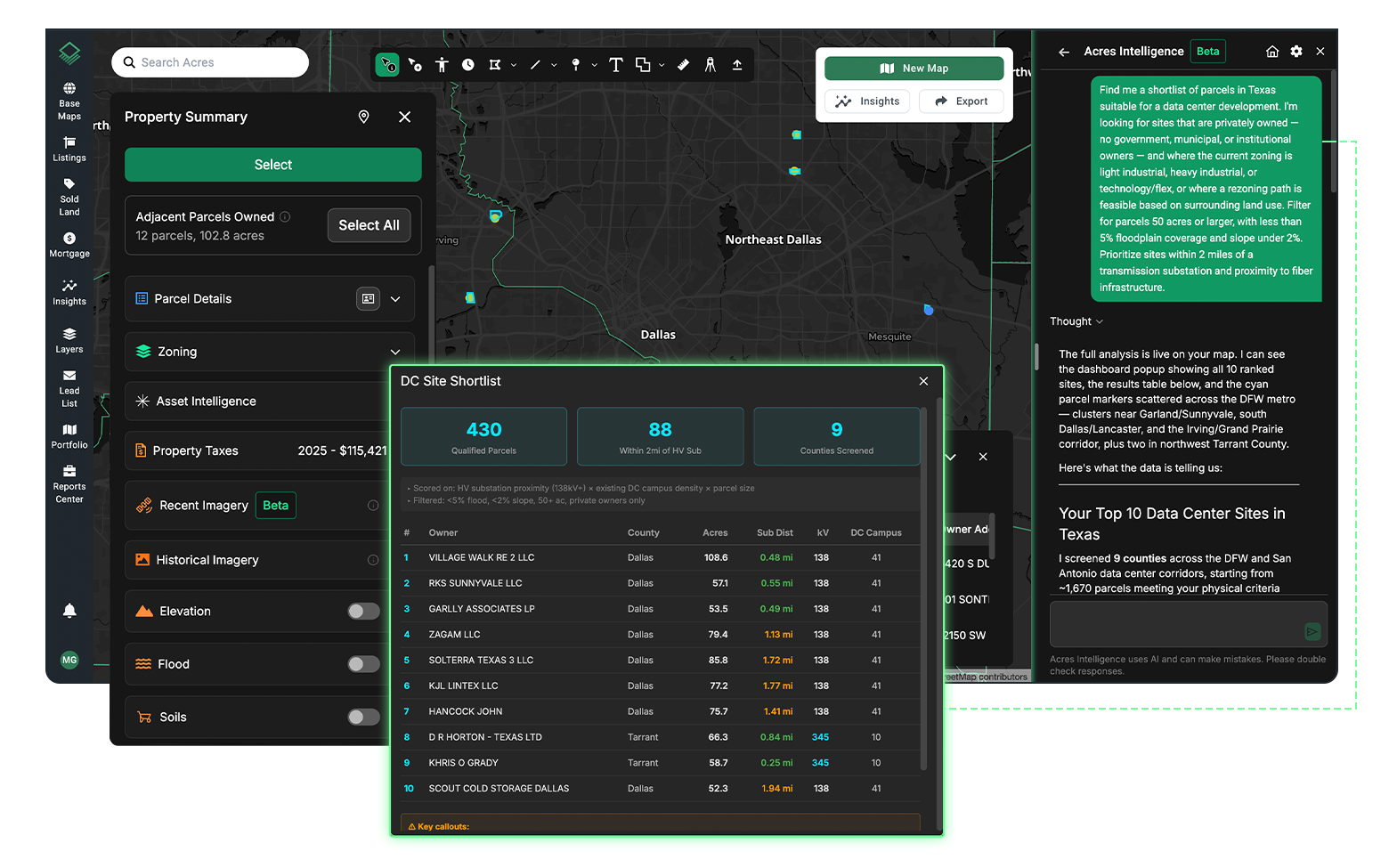
With Acres Intelligence, colocation acquisition and site selection teams can instantly screen land for data center development. Acres’ AI agent can generate a shortlist of suitable parcels based on specific criteria, searching across ownership records, zoning context, moratoriums and civic sentiment, environmental risks, infrastructure signals, and more.
The Colocation Operator as Land Buyer Is a Structural Change, Not a Cycle
The shift of colocation operators from tenants to direct land buyers reflects structural changes in data center economics: compressed vacancy, scale requirements that exceed available developer inventory, geographic expansion into markets with thin broker coverage, and capital structures that can absorb direct real estate risk.
Understanding that buyer set, what they screen for, and how they identify sites is useful context for anyone selling or repositioning land in those markets.