

Land can pass zoning, power, and fiber checks and still stall for a year over a Phase 1 environmental finding nobody flagged early. A Phase 1 environmental site assessment identifies recognized environmental conditions, including historical land use, underground storage tanks, contamination pathways, and similar concerns, that require investigation before a site can be developed.
A site that passes every data center site selection criterion in a standard Site Readiness Gap framework can still be carrying a Phase 1 finding that halts the development timeline for months or years. The traditional framework treats power, water, fiber, and zoning as primary pass/fail screens. Environmental review is the critical fifth dimension that belongs in that same opening pass. Rather than an afterthought, environmental conditions dictate whether a parcel is physically buildable, legally viable, and capable of meeting strict deployment schedules without unforeseen contamination liabilities.
Overlooked Phase 1 findings can introduce substantial delays just when a project appears fully de-risked. Identifying these conditions early is often what separates viable projects from stalled capital. Acres.com surfaces parcel-level land use history, ownership records, and environmental risk context across parcels nationwide, giving development teams the signals to identify Phase 1 risk before formal environmental assessment begins.
Why Does Environmental Review Catch Projects That Zoning Approval Missed?
A 2026 report from Foley and Lardner found that nearly 48% of U.S. data center development breaks down or stalls at the zoning and permitting stage, due largely to misalignment among developers, utilities, and government authorities. Environmental review is one of the primary contributors to that stall rate, particularly for sites with prior industrial history where Phase 1 findings trigger Phase 2 investigation requirements before development can proceed.
Zoning approval and environmental clearance are separate processes administered by different authorities under different regulatory frameworks. A county planning commission that approves a data center zoning application is not reviewing environmental contamination history. A state environmental agency reviewing a Phase 1 assessment is not adjudicating zoning compliance. The two processes do run on parallel tracks, and a site can advance through one track without raising any flags on the other.
What Kinds of Phase 1 Findings Halt Data Center Development?
Phase 1 environmental site assessments often follow the ASTM E1527-21 standard and are conducted by environmental professionals who review the history of a site's use and adjacent properties to identify recognized environmental conditions. The assessment doesn’t involve sampling or laboratory analysis, but it can identify conditions that require Phase 2 investigation, which does involve sampling and can require remediation.
For data center development, many common Phase 1 findings that trigger project delays involve prior industrial use that left contamination or regulatory status behind. Former manufacturing facilities, dry cleaners, gas stations, and automotive service businesses are among the prior uses most commonly associated with soil and groundwater contamination from petroleum products, chlorinated solvents, and heavy metals. Industrial parks, which are frequently targeted for data center land acquisition because of their zoning compatibility and infrastructure access, carry elevated Phase 1 risk precisely because of the industrial history that makes them attractive.
Phase 1 Environmental Findings: Risk Level by Prior Land Use
|
Prior Land Use |
Phase 1 Risk |
Potential Phase 2 Triggers |
|---|---|---|
|
Heavy industrial or manufacturing |
High |
Petroleum products, solvents, oils, heavy metals on site or adjacent |
|
Former gas station or fuel storage |
High |
Underground storage tanks leaks or groundwater petroleum products |
|
Former dry cleaner or textile facility |
High |
Chlorinated solvents or groundwater contamination |
|
Agricultural land (potential pesticide use) |
Moderate |
Pesticide residues or agricultural chemical storage |
|
Commercial distribution and warehousing |
Low-Moderate |
Petroleum from fleet maintenance, miscellaneous chemical storage, or fuel tanks |
|
Undeveloped agricultural/greenfield |
Low |
Off-site migration from adjacent parcels, dumping, or naturally occurring metals in soil in some regions |
|
Brownfield or Superfund-adjacent |
Very High |
Pre-existing regulatory status, active cleanup oversight, or restrictive environmental covenants |
Note: This table reflects typical environmental screening benchmarks and common triggers. Project schedules, regulatory pathways, and remediation scopes depend heavily on local jurisdiction rules, state voluntary cleanup programs, and site-specific hydrogeology. Site evaluation teams should always engage licensed environmental professionals and counsel for parcel-level determinations.
In January 2026, EPA issued guidance for redeveloping Superfund and Brownfield sites as data center sites and launched a dedicated Clean Air Act for data center developers. The guidance reflects growing interest in brownfield redevelopment for data centers, and the corresponding need for development teams to understand the Phase 1 and Phase 2 investigation requirements that apply to those sites before acquisition.
Acres surfaces parcel-level land use history and environmental risk overlays nationwide. Explore land use history and environmental risk screening on Acres.
Why Does Phase 1 Timing Matter So Much?
Hundreds of bills introduced in 2025 created a patchwork of energy, water, and zoning requirements that vary by state and locality. Several of those bills added environmental review requirements for large data center projects, including mandatory Phase 1 assessments before permitting applications are accepted. In states with mandatory Phase 1 requirements, a finding that triggers Phase 2 investigation blocks the permitting clock from starting until the investigation is complete.
The development team that commissions a Phase 1 before signing a purchase agreement is in a far stronger position than the team that discovers a Phase 1 finding during post-option due diligence. In the first case, the finding either disqualifies the site before capital is committed or creates an opportunity to negotiate a lower purchase price that reflects the remediation cost. In the second case, the money has been spent, the development timeline has started, and a finding that requires 12 months of Phase 2 investigation affects a project that is already under capital commitment.
Best practice requires conducting environmental screening before site selection is complete, treating Phase 1 risk assessment as an extension of the site readiness screen rather than a downstream due diligence step. For development teams evaluating industrial sites, brownfields, or mixed-use redevelopment parcels for data center use, early environmental risk identification is what distinguishes a site that stalls from one that delivers on schedule.
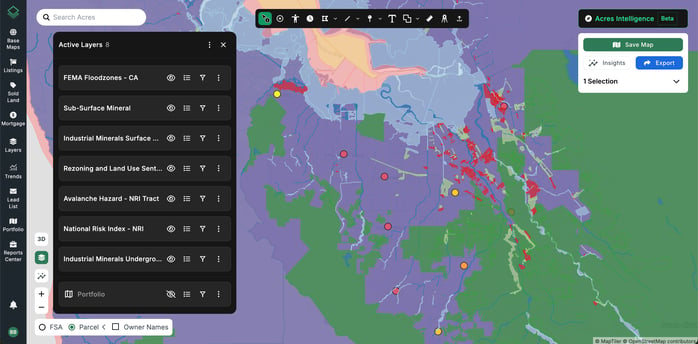
Screen prospective data center parcels with Layers in Acres, evaluating land use history, flood risk overlays, and hundreds of more environmental and regulatory hazards in a single view.
How Acres Supports Pre-Acquisition Environmental Risk Screening
For development teams evaluating whether a candidate parcel carries elevated Phase 1 risk before formal environmental assessment is commissioned, Acres provides the land use classification and environmental context that can identify risk characteristics at the parcel level. The preliminary screen that helps prioritize which sites should receive early Phase 1 assessment is available nationwide in a single platform. Screen for Phase 1 risk before your next acquisition on Acres.
Environmental Risk Should be a Critical Screen, Not a Post-Acquisition Discovery
The data center development teams that avoid Phase 1 delays are the ones that run environmental risk screening in the same sequence as power, water, fiber, and zoning screening, treating it as a pre-option filter rather than a post-option confirmation. For industrial, commercial, and brownfield sites, early screening is what helps prevent a one-year investigation from becoming a one-year project delay after capital has been committed.